


Vienna offers its visitors museum complexes, historic buildings, flower gardens and a rich calendar of events. With the Prater, the many cafes, the trendy clubs, the Danube island, the capital makes you enjoy moments of culture, leisure and relaxation. I visited Vienna for New Year’s Eve 2024, we stayed for 4 days and had a busy calendar of activities, including visits to museums and famous gardens, evenings enjoying classical concerts, breakfast appointments in historic cafés, sunset on the Ferris wheel. Vienna is by its nature a historic and romantic city, but in my case it was even more so because on January 1, 2024, under the Vienna sky flooded with fireworks for the start of the new year, my boyfriend proposed! So Vienna will always be in my heart and will be a city I will always have a special connection with!
10 things to do in WIEN DURING CHRISTMAS PERIOD

1. START YOUR DAY AT CAFE SACHER WITH TYPICAL VIENNESE BREAKFAST
How to start our holiday if not with a delicious breakfast in one of the most historic and famous cafés in Vienna? The hour-long queue will be worth it when you take a seat in the colorful bar and they serve you a slice of the typical Sacher cake, to start the day with the right dose of sweetness. Everyone knows the famous Sachertorte, the tasty chocolate and apricot jam cake typical of Austria. But perhaps not everyone knows that it was invented by the pastry chef Franz Sacher in Vienna, in the restaurant-pastry shop of what is now the Hotel Sacher. Today, the café Sacher in Vienna, i.e. the hotel bar, is an opportunity to taste the dessert in its original recipe, and to take a dive 200 years into the past to immerse yourself in the typical atmosphere of an ancient Viennese café, decorated in shades of white and red, with abundant decorations and elegant chandeliers. The cake must absolutely be accompanied by one of the typical Viennese coffees, long and in some cases alcoholic.
I treated myself to a Maria-Theresia coffee, that is, a double espresso served with orange liqueur and topped with whipped cream. Inside the Sacher café there is also a corner where you can buy gifts or souvenirs, the Sacher Shops, obviously specialized in cakes, chocolates and various sweets, beautifully packaged.

2. CLIMB THE STEPHANSDOM TOWER TO ADMIRE THE VIEW OF THE CITY FROM ABOVE
St. Stephen’s Cathedral is the metropolitan cathedral of Vienna. It is located in the square of the same name, the Stephansplatz. The monumental building is one of the symbols of the city, and the Viennese call it “Steffl” from the term that designates the medieval spire of the bell tower. There are many options here: the elevator in the northern tower takes you up to Austria’s largest bell – the Pummerin, one of the tallest in the world, visible from almost every point of the city, whose tolling on New Year’s Eve heralds the new year. Athletes climb the 343 steps to the Türmerstube (tower tavern) and enjoy the view of Vienna and part of the 230,000 roof tiles of the “Steffl”. The brave dare a guided tour through the catacombs – an underground burial place. Can you guess which activities we did during our stay?
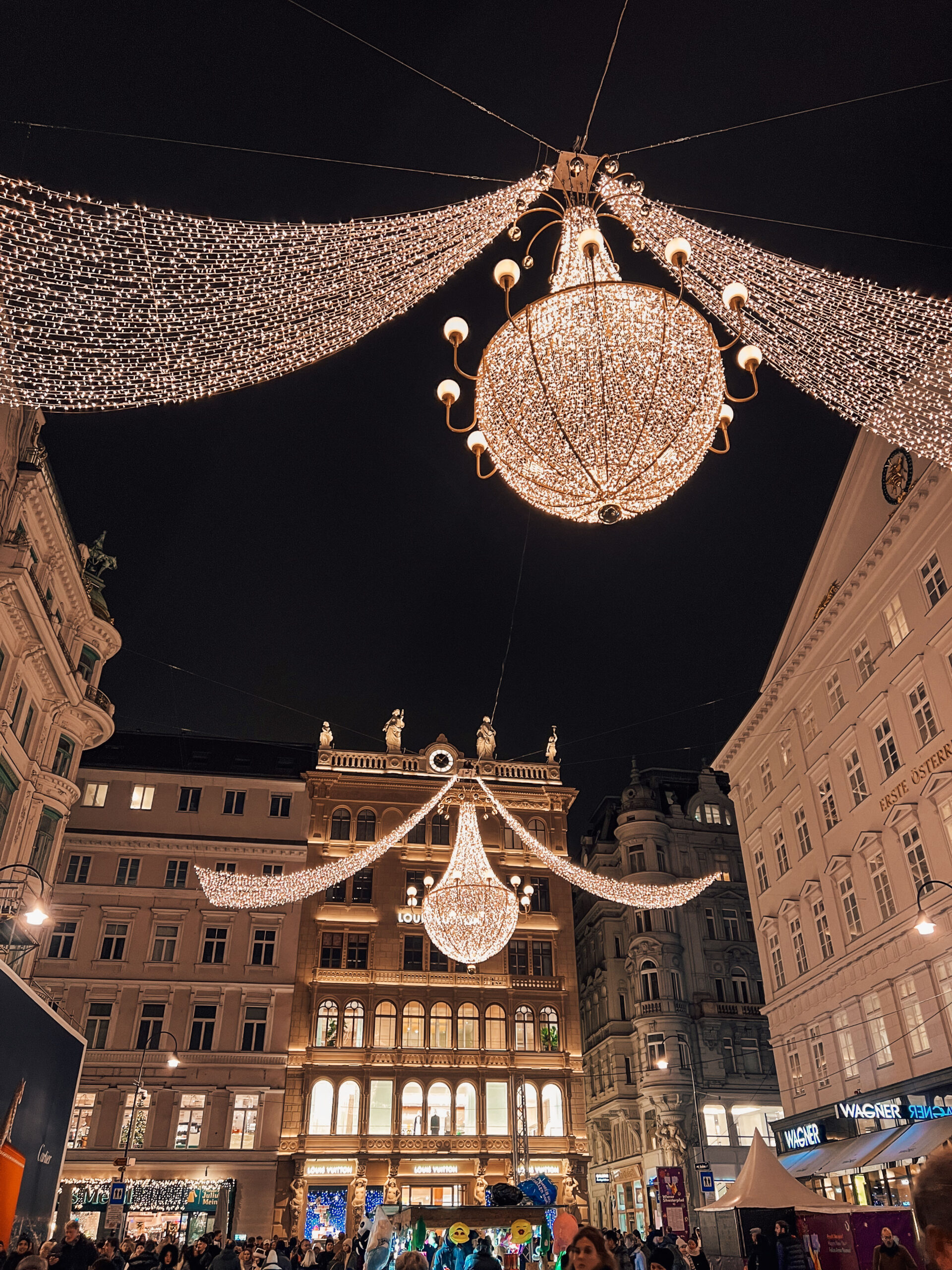
3. SPEND THE EVENING IN THE HISTORICAL CENTER TO ADMIRE THE CHRISTMAS DECORATIONS
Advent in Vienna is an exciting journey full of surprises, even if you are not a particular Christmas lover you can’t help but fall in love with it! Enchanting Christmas markets, ice skating, the cozy warmth of a Viennese café or the numerous museums, lively dance evenings: these are the Viennese winter dreams. From mid-November the most beautiful squares in Vienna are transformed into enchanting Christmas markets. And in the evening, a walk through the city center absolutely must not be missed, in fact nothing creates the Christmas atmosphere like the twinkle of fairy lights in the streets of Vienna. The ultimate Christmas atmosphere awaits you in the Rotenturmstraße. Its very large red spheres have been part of the city’s fixed decorations in the pre-Christmas period for many years now. But my favorites are the lights a few minutes walk from Annagasse, here a view opens up to the eyes of passers-by that can leave you astounded: the Graben in Vienna is adorned with grandiose Christmas lights that recall in their shape the large ceiling chandeliers.

4. WALK IN THE IMMENSE GARDENS OF THE BELVEDERE PARK
The Belvedere Palace was built to be the summer residence of Prince Eugene of Savoy. This total work of art in the Baroque style consists of two castles: the Upper Belvedere and the Lower Belvedere. The Upper Belvedere stands on a hill from which you can enjoy a fabulous view of Vienna, and houses the largest collection of Klimt paintings in the world including the painting “the Kiss”. While the upper Belvedere was used for representation, the lower Belvedere was used as the residence of Prince Eugene of Savoy. Also, one of the most breathtaking things about the Belvedere Palace is its garden. The Belvedere Garden is the highlight of Baroque landscape architecture. The numerous fountains, mythological sculptures, ground ornaments and flowerbeds connect the two palaces. A reflection pond was placed in front of the castle, which reflects the facade of the building. Enjoy the walk in the immense garden before arriving at the Upper Belvedere and be enchanted by the winter view of Vienna

5. WARM UP WITH THE PUNCH SERVED IN THE SWEETEST CUPS
During our holiday in Vienna, I couldn’t even tell you how many glasses of punch we had around the city to warm ourselves up, we couldn’t resist! There are numerous stalls in the main attractions of the city, and after a visit to a museum or garden and a walk in the Viennese winter cold, how could you not warm up with a good hot punch? Punch belongs to the pre-Christmas period like Christmas biscuits or Christmas markets. For the rest of the year little is drunk but a glass or rather a cup of mulled wine in front of a stall at one of the Viennese Christmas markets is almost a must. During the Christmas period it is then served in very sweet cups with various local attractions drawn, so that even once you return home it remains a lovely memory of the Viennese holiday

6. WATCH THE SUNSET FROM RIESENRAD, THE FERRIS WHEEL IN THE PRATER
At the Prater, with its 250 attractions, you certainly won’t get bored: autodrome tracks, shooting booths, roller coasters, horror trains and even flight simulators.
The varied offer is complemented by numerous cafés and restaurants, buffets and food kiosks. During the Christmas period, it is crowded with families with children running from one attraction to another and is filled with stalls selling sweets, snacks of various types and obviously hot drinks, alcoholic and non-alcoholic. We arrived at the Prater after spending the morning visiting the Belvedere palace, and it was almost sunset time. We immediately went up on the Ferris wheel, we couldn’t miss one of the symbols of Vienna. From a height of almost 65 meters we enjoyed magnificent views of the city at sunset and saw the darkness of the evening fall on the city. After this very suggestive moment, we stopped at one of the stalls in the Prater to enjoy a hot chocolate, in one of the very sweet viennese Christmas mugs.

7. STOP AT ONE OF THE MANY CHRISTMAS MARKETS AND TASTE THE TYPICAL GULASCH
As regards the Viennese tour, the advice is to start your journey from Rathaus, or Rathausplatz, or from the town hall square; here there are many markets and you will find anything, including an ice rink in the center of the square.
We at Rathaus particularly appreciated the gulasch served in bowls made with bread. It is truly an unmissable stop, also considering the popularity of this dish among the Viennese.
Viennese gulasch has its origins in Hungary. At the beginning of the 19th century the spicy meat dish entered Viennese cuisine and developed into numerous varieties, which demonstrate its popularity. In Vienna, “Saftgulasch” (literally “broth goulash”) is particularly popular. Its main ingredients are lean meat and onions which are the secret of every good goulash. Rough rule of thumb: the amount of onions should be at least three quarters of the amount of meat!

8. DRESS ELEGANT AND ATTEND A CLASSIC MUSIC CONCERT
In Vienna every evening 10,000 music fans attend live classical music concerts: this doesn’t happen in any other city in the world. In general I am not a fan of classical music concerts, but I immensely enjoyed the concert of Strauss and Mozart, nothing makes you feel more immersed in the Viennese atmosphere. There are many concerts throughout the city, we chose the Kursalon. As soon as we arrived, and after leaving our coats in the cloakroom, we were immediately accompanied to the dinner room in the internal restaurant, Das Johann, where the 4-course dinner began at around 6pm.
At around 8.30pm dinner ends and we are invited to go to the concert hall, where the classical music concert begins. But there is not only music: waltzes and polkas are alternated with songs performed by opera singers or ballets. During the concert there is an interval in which a glass of sparkling wine is offered, and at the end of the concert a CD of Viennese classical music is given as a gift. Very important information: the dress code is formal and elegant, we had to wear suit and dress!

9. RELIVE THE HISTORY OF THE MONARCHS IN THE HALLS OF THE SCHöNBRUNN PALACE
Schönbrunn Palace is one of the most beautiful baroque buildings in Europe. The Palace is today part of the UNESCO world cultural heritage, by virtue of its historical value, unique location and sumptuous furnishings.
Schönbrunn Palace has a total of 1,441 rooms; of these, only 45 can be visited. Numerous historical personalities have populated its rooms over the centuries: in the Hall of Mirrors of Schönbrunn Palace, the child prodigy Mozart played at the age of six. In the Vieux-Laque room Napoleon conferred. The Chamber of Millions, covered in rosewood and decorated with precious miniatures from India and Persia, is considered one of the most beautiful rococo rooms in the world. If you want to know more about his history, you can enjoy a 24-minute virtual reality film, through digital glasses and 360° immersive content and relive the history of the palace and the daily lives of the monarchs, and there is no shortage of detailed descriptions of the lives of the two radiant personalities of Emperor Franz Joseph I and Empress Sissi. But that’s not all, the garden is also a work of art: it houses impressive fountains, statues, monuments, trees and flowers and the sumptuous Gloriette.

10. TAKE A ROMANTIC FIACRE RIDE AROUND THE HOFBURG
The French word “fiacre” refers to the carriage stop on the Parisian street Rue de Saint Fiacre. In 1720 the carriages in Vienna were also renamed “Fiaker“. The boom from then on was unstoppable: between 1860 and 1900 more than 1,000 fiacres were in circulation in Vienna. The carriage drivers were often original characters, known by everyone in the city, who loved to perform, among other things, as singers. They were appreciated for their discretion, especially when one or the other fine gentleman was amusing himself in the “fiacre” with his paramour.
Today, Viennese fiacres are inseparable from the image of the city. You can find horse-drawn carriage stands in different areas of the city, and a sunset ride passing in front of the fully illuminated Hofburg Palace will be the most romantic note of the whole holiday.
Fiacres are as much a part of Vienna as St. Stephen’s Cathedral and the Ferris Wheel. There is almost no cozier way to explore Vienna’s attractions.
When to go?

Winter
Winter in Vienna is cold, with minimum temperatures of -2° and maximum temperatures of 4° in December. Despite the cold, the city in the month of December is particularly evocative due to the preparations for the Christmas holidays, the Christmas markets and the decorations that adorn the shops.

Spring
Spring, especially the month of May, is the best time to visit Vienna both for the climate and because it rains less than other seasons.

Summer
June, July and August are the hottest months but also the rainiest. The month in which there is a greatest concentration of rain is June in which on average there are 9 rainy days, followed by July and August.

Autumn
The autumn months are dry and cool. In September and October the temperature is still pleasant, but already from the following month it drops significantly.

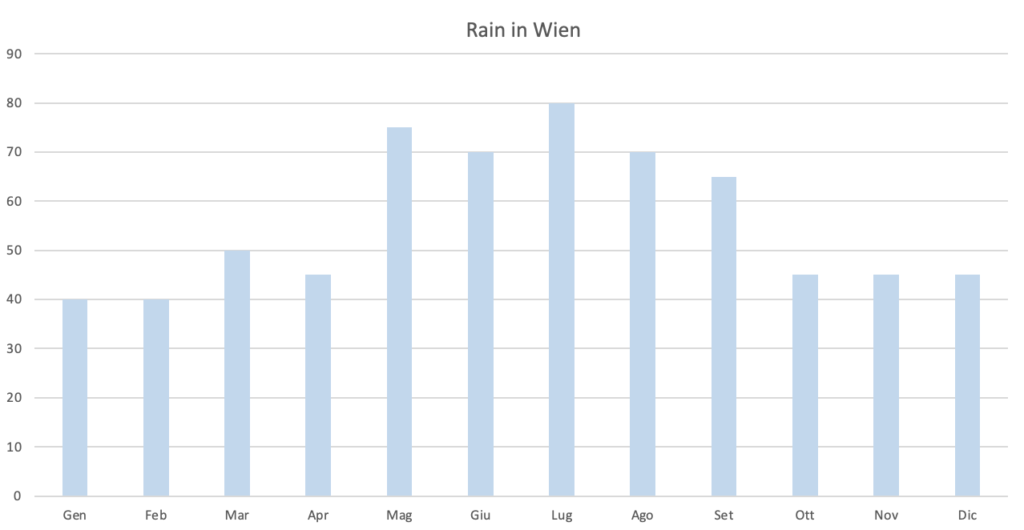
The best times to visit Vienna are the spring and autumn seasons, to avoid the winter cold and the summer heat, and in particular the months of May, June and September: the daytime temperatures are pleasant, although it is advisable to bring a sweater or jacket for the evening.
three unmissable stops
Best photos spots
I’m a photographer, so I’m always looking for the best corner in the world to make the perfect picture. Often, with great pleasure of my traveling companions, I also spend hours staring at the landscape, waiting for the perfect moment with perfect light. Therefore, when I decided to create my blog, I could not avoid to include a dedicated section to photography enthusiasts like me, always looking for the landscape that leaves you breathless. Hope you will enjoy these places where, in my opinion, you can enjoy wonderful landscapes and take the best pictures.


0 Comments